Fredosor
  • Home
  • The Universal Ego
    • Nature's call - on hold
    • Narcissus unbound
    • Freedom and social interaction >
      • Breaking the Chains
      • Solitary Navigation in Space
    • Human capital
    • The dream of enlightenment
    • The blinding light of modernity
    • Unleashing our little helpers
    • Vanishing borders
    • Foundations of ideology
    • Francis Bacon's idols
    • Tao's four desires
    • The four ends
    • Keys to life >
      • The Global Soul
    • The magnificent four
    • The Etruscans
  • Cultures
    • Culture - spatial starting point
    • Culture - timeline starting point
    • Culture - activity starting point
  • Lights
    • The Universal Masters of Thinking >
      • The Philosophy of Antiquity
      • Philosophy of the Middle Ages
      • Philosophy of the 1500s
      • Philosophy of the 1600s
      • Philosophy of the 1700s
      • Philosophy of the 1800s
      • Philosophy of the 1900s
    • Joseph Campbell >
      • Primitive myth - images and imprints
      • Primitive Hunters: Paleolithic
      • Primitive Hunters: Shamanism
      • Primitive myth - planters
      • Occidental Mythology >
        • The Serpent' Bride
        • The Consort of the Bull
        • Heroes of the Levant
        • Heroes of the West
        • The Persian period
        • Hellenism
        • Great Rome
        • Cross and Crescent
        • Europe Resurgent
      • Four great domains
      • The Cities of God
      • The Cities of Men
      • Ancient India
      • Buddhist India
      • The Indian Golden Age
      • Chinese Mythology
      • Japanese Mythology
    • Marcel Proust
    • Bourdieu
    • Carl G. Jung
    • Dante
    • Montaigne's Essays >
      • Montaigne's Essays; Book I
      • Montaigne's Essays; Book 2
      • Montaigne's Essays; Book 3
    • Seneca
    • Gaston Bachelard - The Present
  • Imagination
    • Erasmus' Folly
    • Cerebral challenges
  • Fundamentals
    • Demography
    • The global environment
    • Social cohesion >
      • Social cohesion: freedom and equality
      • Social cohesion: welfare state
      • Social cohesion: minimax
  • Places
    • Random walks
    • Akershus
    • Amboise
    • Azay-le-Rideau
    • Blenheim Palace
    • Blois
    • Bussy-Rabutin
    • Chambord
    • Chaumont
    • Chenonceau
    • Fontainebleau
    • Neuschwanstein
    • Palacio da Pena
    • Chateau de Saumur
    • Source-Coquille
    • Vaux le Vicomte
  • Blog

Picture
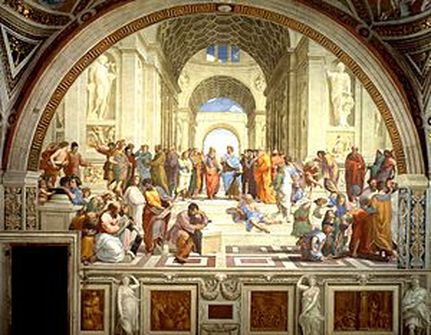
Raphael: The Academy at Athens; Wikimedia Commons


The Universal Masters
of Thinking


Ever since our history has been put down in writing, we have been blessed with accounts of the ideas of great minds. These great minds who have reflected on the human condition and the relation of humans with the universe have produced ideas and outlooks that are with us still, and will be with us as we develop our ideas further. If we use the time line as our way of presenting who these thinkers were and what their main ideas were, we need to start with Antiquity, when our written history of thinking came into being. After that we look at the Middle Ages, and then – still using the time line as our classification -  the 1500s, the 1600s, the 1700s, the 1800s, and the 1900s. In doing this, we base our overview on the excellent book of professor Trond Berg Eriksen of the University of Oslo: "Undringens labyrinter" (in English, the title would presumably be: "The Labyrinths of Wondering"; 1998). The 2000s is still in its beginning, and it seems better to wait before trying to give an overview of our present century.

Proudly powered by Weebly